Showing posts with label Politics. Show all posts

Tuesday, March 23, 2010

Yes, Virginia, There Is Health Care Reform, or, What Would Jesus Repeal?

Health insurance reform has passed Congress and been signed into law by President Obama, ushering in the most sweeping overhaul of health care in over a generation. So what happens now? I think it is instructive to look at two questions. First, Republicans are loudly clamoring for repeal. Can it happen? Second, what parts of this law are so egregiously un-American and unconstitutional that they would merit immediate repeal lest the Nation fall by sundown?

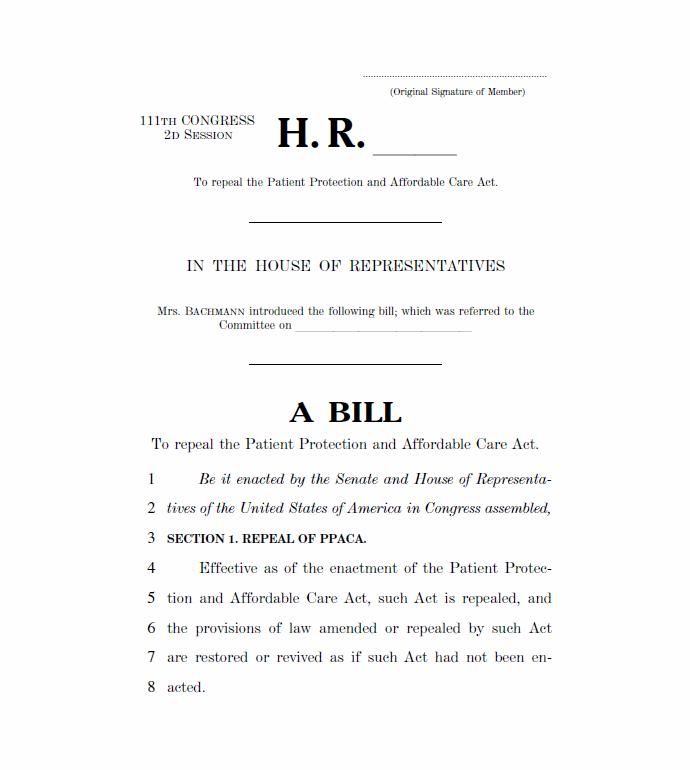
Republicans are already banging the drum to repeal the new health insurance reform law. Reps. Steve King (R-IA) and Michele Bachmann (R-MN) have introduced one-page bills to repeal the entire Act. Six senators and forty-six representatives have already signed the Club for Growth’s repeal pledge, along with almost 200 congressional candidates. Republican presidential hopeful Mitt Romney is even calling for repeal – an interesting pivot from signing a very similar law when governor of Massachusetts. But is this real, or just bluster?

Firstly, it will not happen before 2011 in this Congress, because if you don’t have the votes to stop something from becoming law, then you don’t have the votes to repeal it. Secondly, after such a battle to pass the law, any partial or full repeal would be vetoed by President Obama, and Republicans and lack the votes to override a veto. Gaining enough votes in Congress to override a veto before the end of Obama’s first term would require Republicans to pick up 25 Democratic seats in the Senate plus Sen. Joe Lieberman (I-CT), or 26 seats without him. As there are only 16 Democrats up for re-election in the Senate in 2011, this is an impossible feat. Further, Republicans would have to win over at least 113 seats in the House in 2011, a number not approached since the Republicans lost 100 seats in the 1932 election at the end of the disastrous Hoover administration.

But now that it is clear why repeal won’t happen, let us humor Republicans for the moment and imagine that it could. Just what parts of this bill are so socialist, Marxist, communist, or any other -ist that they pose a threat to freedom, democracy, apple pie, baseball, and the future of America?

  • Alabama’s PACT (Pre-pay a Child’s Tuition) college funding program is on the verge of collapse. The jobless rate for college-age veterans is over 21%, and for other college-age adults is 16.6%. Many young adults are still living at home or depending on their families as they try to pay for college or find a job. Does Rep. Parker Griffith (R-AL 05) want to repeal the right to keep their children on their family insurance until they turn 26 for the thousands of middle class families in his district – many of whom rely on the Defense Department for their livelihoods?
  • Nearly 15% of the residents of northwestern North Carolina are “lacking the resources to meet the basic needs for healthy living; having insufficient income to provide the food, shelter and clothing needed to preserve health.” Many of them rely on the help of six community health care centers that care for the poor and medically underserved. Does Rep. Virginia Foxx (R-NC 05) want to repeal the nearly $8 million in federal assistance for community health centers?
  • More than one-fifth of the residents of Florida’s 16th district are Medicare beneficiaries. Currently, these 171,000 seniors and other Medicare-eligible residents are responsible for $4,550 in true out-of-pocket prescription drug expenses before catastrophic coverage kicks in. Does Rep. Thomas Rooney (R-FL 16) want to repeal the elimination of the Medicare Part D doughnut hole over the next decade, costing the seniors of his district millions of dollars out of pocket, and forcing them to continue to decide between medicine, food, and other necessities?
  • Millions of Americans are uninsured and have pre-existing conditions like cancer and heart disease, including 16,000 residents of northwest Texas. For-profit insurance giants will not provide coverage to these citizens because there isn’t any money to be made in caring for them. As a result, some of these uninsured adults and children cannot get the care they need, and they die. Does Rep. Randy “Baby Killer” Neugebauer (R-TX 19) want to repeal guaranteed coverage for individuals with pre-existing conditions, or does he want private for-profit insurers to continue to have the right to deny care, allowing uninsured individuals, including babies, to die?
  • More than half a million residents of Minnesota’s 6th district are insured through their employers or have purchased their own insurance. While this district has one of the highest rates of insurance in the country, its citizens are still subject to lifetime coverage limits, rescissions, rejections for pre-existing conditions, and wasteful private insurer spending. Does Rep. Michele Bachmann (R-MN 6) want to repeal prohibitions on annual and lifetime coverage limits, and prohibitions on rescissions when policy holders get sick and need their insurance the most, and prohibitions on denials for pre-existing conditions, and limits on company administrative spending and profits?
  • Hundreds of thousands of families face financial ruin every year, having to file for bankruptcy because of uncovered health care costs. Part of this is due to policies of for-profit insurers, raising premiums by a third or more annually, and dropping policyholders when they get sick. Around 1,700 of these bankruptcies were in Nevada’s 2nd district, comprising most of the state outside of Clark County. Does Rep. Dean Heller (R-NV 2) want to repeal caps on annual out of pocket costs for those insured in exchanges or through private business, and bans on annual and lifetime limits?
  • New deficit hawks who have suddenly seen the light now that Iraq is occupied and George Bush is out of office – Republicans like Texas’ Jeb Hensarling (R-TX 5) – are beside themselves with glee at the political points to be scored from Obama’s deficit spending. They never mind the fact that the spending is necessitated by the circumstances of the country created by eight years under Bush. So if he really cares about the deficit, does Rep. Hensarling want to repeal health insurance reform that helps millions, improves lives, keeps families together and healthy, while reducing the deficit by $130 billion in the next ten years, and by over a trillion dollars in the next twenty years (depending on GDP growth)?

So which of these will it be?

Wednesday, October 28, 2009

Name that candidate

Courtesy of Pollster.com, CNN and Opinion Research Corporation have a new poll out today regarding the 2012 presidential election, potential candidates, and their approval ratings and strengths. Regarding one politician who is frequently discussed as a candidate in 2012, their polling found the following:
Not a typical politician: 65% Applies, 34% Does not apply
A good role model...: 64 / 35
Care about the needs of people like you: 56 / 43
Is honest and trustworthy: 55 / 43
Shares your values: 49 / 49
Generally agrees with you on issues you care about: 48 / 50
Is a strong and decisive leader: 47 / 51
Have you guessed the candidate yet? Most non-incumbents would envy numbers like this, and it would lead you to believe that the candidate would be in a strong position heading into 2010. But then check out the bottom line:
Qualified to be president: 29 / 71
Have you figured out that the candidate is Sarah Palin? Even among Republicans, the margin is only 52 /47 (4.5% MOE). Her favorability rating is 42 /51 in the same poll. So if she is strong in these traditional measures of candidate values and strengths, what is it about her that makes seven in ten Americans think she is unqualified to be president?

I think the key is in the last strengths question - is she a strong a decisive leader? She receives her lowest marks in this category, and it would be a concern for any candidate to have low numbers on this criteria. But worse for Palin, her decisiveness is sometimes misguided and unintelligible. Two of her biggest decisions involved quitting public positions - one because of a lack of ethics of others, and the second because of a lack of ethics on her own part. In a crisis, will she quit?

All of this, of course, is purely academic. Everyone involved in the Palin follies of 2008 is turning their backs on everyone else and seeking to cash in for themselves. Palin knows, or has been told using very small words, that she could rouse a base of her party a la George Wallace, but she could never win the nomination or the election. Better to strike while the iron is hot, take her place along side Newt Gingrich as post-political party elders, and bring in hundreds of thousands of dollars in public appearance fees.

At least the Miss California pageant could strip Carrie Prejean of her title, limiting her scope and impact. The Grumpy Old Party has stuck us with Sarah.

Sunday, March 01, 2009

Leaving Rush Limbaugh

I lost a friend today over Obama's budget, of all things. He displayed a graph on his blog showing the dramatic increased in proposed deficit spending in Obama's next budget. I explained to him that a large part of the reason for this was that Obama eliminated a lot of accounting tricks used by the Bush administration, particularly regarding war spending, to make the deficit look better than it was. He response to me was that I needed to stop "drinking the Koolaid [sic]". And so I explained to him that the reason I was able to stay good friends with some of our mutual friends with whom I disagreed was because we could discuss and disagree and be civil. If he was unserious enough that he had to resort to name-calling, then we could no longer be friends. Sure, that was my choice, but we face serious problems, and now is not the time for people without solutions to get in the way.

Yesterday, on a drive across North Carolina, I listened to Rush Limbaugh's address to CPAC. And I have come to the same conclusion about him.

"[T]he racism, the sexism, the bigotry that we're all charged with, just so you across the United States of America know, and you'll see demonstrated here as the afternoon goes on, doesn't exist on our side. We want everybody to succeed."

Really?

Rush, you are a racist. You have been a racist across four decades of "excellence" in broadcasting. In the 70s, you told a black caller to "Take that bone out of your nose and call me back." In the 90s, you said "Have you ever noticed how all composite pictures of wanted criminals resemble Jesse Jackson?" When Carol Moseley-Braun, the first African-American woman in the U.S. Senate, was mentioned on your show, you would play the theme "Movin' On Up" from the television show "The Jeffersons". When a caller told you that black people need to be heard, you replied, "They are 12 percent of the population. Who the hell cares?" You even claimed that Donovan McNabb, the long-time Philadelphia Eagles quarterback, got too much credit for the success of his team because he was black, and that the media wants to see blacks do well. And you opined, "Look, let me put it to you this way: the NFL all too often looks like a game between the Bloods and the Crips without any weapons. There, I said it."

This is not the surface racism that has some people referring to "good niggers" and "bad niggers". And these are not the once-in-a-lifetime racial misquotes of a sincerely open-minded person. These are the philosophical statements of a man who clearly believes to his core that non-whites are less than whites. Someone who believes that whites are superior. Someone so unserious that he will viciously insult millions of people to get laughs from millions of other people.

You are a racist, Rush. There, I said it.

Oh, did I mention that you are a sexist bigot, too? Using a drawn out syllable to call Hillary Clinton a "bitch" while claiming you didn't. Stating that John Edwards' wife "might be attracted to a woman whose mouth did something other than talk." Claiming that Rev. Al Sharpton was concerned about the Duke lacrosse rape case because he was "trying to figure out how he can get involved in the deal down there at Duke where the lacrosse team ... supposedly, you know, raped some, uh, hos." [Racism AND sexism – a two-fer!] Repeatedly referring to women activists as "feminazis" (a quick search of your website shows over 60 uses of the term). And even in this speech, calling CBS's Maggie Rodriguez an "anchorette," and then jokingly apologizing for it.

And now, you want to convene a summit of women because "I want some of these women to start telling me what it is I must do to close the gender gap — or, if not what it is I must do to close the gender gap, what it is I've done that has caused the gender gap." I thought you were a man of principles, Rush. A man who is telling conservatives not to change, that, like a diamond, "conservatism is…forever". Yet you are willing to ask women what you "must do" – differently, of course – to win their support.

"Also, for those of you in the Drive-By Media watching, I have not needed a teleprompter for anything I've said. [Cheers and Applause ] And nor do any of us need a teleprompter, because our beliefs are not the result of calculations and contrivances. Our beliefs are not the result of a deranged psychology. Our beliefs are our core. Our beliefs are our hearts. We don't have to make notes about what we believe. We don't have to write down, oh do I believe it do I believe that we can tell people what we believe off the top of our heads and we can do it with passion and we can do it with clarity, and we can do it persuasively."

Racist, sexist, and now hypocrite.

"We believe that person can be the best he or she wants to be if certain things are just removed from their path like onerous taxes, regulations and too much government."

"We don't want to tell anybody how to live. That's up to you."

Then why are you in my bedroom? Why are you telling me what I can and cannot do with my body, the one gift with which I was endowed by my "Creator"? Why are you telling me I can love anyone I want, as long as you approve of my choice of gender? Am I not a better person, a happier person, a better contributor to society, if I am free to love who I want, and to have his support in my life? If I love someone, and my government tells me, "No, you are not allowed to love him," won't that make me less happy? Won't it make me resentful? And, in Republican terms, won't that make me a less productive input into GDP? If I am unhappy at home, and in my most intimate, personal choices and commitments, how can I be fully happy in anything else I do? How can I reach my potential and be the "best" that you say you want me to be?

You are also a liar, Rush.

"They don't have the right to take money that's not theirs, from the back pockets of producers, and give it to groups like ACORN, which are going to advance the Democrat Party."

First, neither President Obama nor the Congress is trying to give money to ACORN. (Paraphrasing Jerry Seinfeld, "Not that there's anything wrong with" ACORN.) But it is a lie to say the ARRA is going to give them money. ACORN is eligible for grants in the act, just like you are. But it would be just as much a lie for me to state on my blog that "Republicans in Congress allowed a bill through that would take your money and give billions to Rush Limbaugh." Further, it is true that the money is not "theirs". But that is a spurious argument. This is a republic. We chose representatives to make decisions for us. And the majority of those representatives set the tax and revenue policies, and set the priorities for spending. The money is ours, but we have given the authority to spend it to them. If you don't like that, perhaps you should win a few elections and change it.

"In fact, the money he's spending is not ours. He's spending wealth that has yet to be created. And that is not sustainable. It will not work. This has been tried around the world. And every time it's been tried, it's a failed disaster."

Your willful hypocrisy and irony are blinding, Rush. You cannot admit that this is exactly what Ronald Reagan and George W. Bush both did for 16 years. They spent our great-grandchildren into a gaping hole. And you are correct that it is not sustainable. It is an aggravating factor in the current economy. Reagan and George H. W. Bush spent us trillions into the hole. Clinton reversed the trend and even passed four consecutive surplus budgets. Bush has done even worse deficit spending than his father, and that doesn't include all the war spending accounting tricks to make the deficit look better than it was. I've seen the charts showing Obama's proposed budget and deficit spending, some estimates up to $2.5 trillion in one fiscal year. I don't know where the final number will end up. But I know that because of the inaction and failures of the last several years, drastic measures are required.

"Spending a nation into generational debt is not an act of compassion."

Then how come it was okay when "compassionate conservative" George W. Bush was doing it? He added trillions to the national debt.

"I have learned how to tweak liberals everywhere. I do it instinctively now. Tweak them in the media. And no reason to be afraid of these people. Why in the world would you be afraid of the deranged? There really is no reason to be afraid of them. And there's no reason to assume they're the minority. And there's no reason to let them set all the premises and all the agendas to which we respond to."

Again, calling names is not a strategy. Referring to my party as the "Democrat Party" seven times because you think it tweaks us is not a solution; it is childishness. But I have a better rebuttal.

"We, ladies and gentlemen, have challenges that are part and parcel of a movement that feels it has just suffered a humiliating defeat when it's not humiliating. This wasn't a landslide victory, 52 to, what, 46. Fifty-eight million people voted against Obama."

Actually, had you wanted to be more negative, you could have said that almost 62 million people voted against Obama. But almost 70 million Americans did choose him. Obama beat McCain by 9,500,000 votes, the largest margin of victory since 1984. Your party lost 14 seats in the Senate and 53 seats in the House in the last two elections – that's nearly one-quarter of your members. So it is not just at the national level that your ideas have lost. They have also lost among the 435 individual constituencies in our country, too. Your platform did not just lose one election – it has lost dozens.

"We don't have the votes in Capitol Hill to stop what's going to happen. What we can do is slow it down, procedure, parliamentary procedures, slow it down and do the best we can to inform the American people of what's really on the horizon."

And now you're making sense. You don't have the votes to win on most party line issues. But you don't propose better ideas, ideas that can win. Instead, you suggest obstruction and delay. Just like insults, neither of these ideas will make someone's life better.

"[Obama] wants people in fear, angst and crisis, fearing the worst each and every day because that clears the decks for President Obama and his pals to come in with the answers, which are abject failures, historically shown and demonstrated."

I'm sorry, Rush, are you sure you didn't mean President Bush? Because after 9/11, Bush had the chance to unite this country and to ask us to sacrifice as Americans for the common good. Instead, he and his people sowed fear, doubt and mistrust among and between us, and used the uncertainty and the confusion to soil the Constitution, the document you claim to love. Do you only love it during Republican eras?

"When I look out at you in this audience, I don't see a Walmart voter. And I don't see a black, and I don't see a woman, and I don't see a Hispanic. I see human beings who happen to be fortunate enough to be the luckiest people on Earth since you are Americans."

Actually, Rush, I think the reason you didn't see a black, or a woman, or a Hispanic, or a Wal-Mart voter in the room is because there weren't any at CPAC! But I digress with my snarkiness…

"So as you leave here, as you leave here optimism, confidence, not guilt, it's not worth it. There's nothing to be guilty about. Don't treat people as children. Respect their intelligence. Realize that there's a way to persuade people. Sometimes the worst way is to get in their face and point a finger. Set up a set of circumstances where the conclusion is obvious. Let them think they came up with the idea themselves. They'll think they're smart that they figured it out. Who cares how you persuade them, the fact they can be persuaded is factually correct, it's possible"

So regarding what position are you trying to persuade me? What ideas do you have for leading our country? You claimed to detail what conservatism is, but you barely scratched the surface. And other than jokes, and pointing fingers, and calling names, you have not suggested any alternatives. Do you want Republicans to be in charge, making the decisions, and driving the agenda again? Of course you do. So suggest something. As long as you have no ideas, as long as all you can do is tear others down, your good wishes for our country will not matter. You will not win elections.

"Joe Biden was mystified how Bobby Jindal got his shift off at 7-Eleven that night to make the speech. Wait a minute. Wait a minute. Time out. Suspend speech for explanation. People watching at home. I'm glad this happened. Glad this happened. You think I just made a joke, an ethnic joke about Bobby Jindal, don't you? I didn't. I made a joke about the bigotry of the Vice President of the United States, Joe Biden."

I try to keep myself open-minded. I don't prefer people who are mindless followers of any media personality. Yet I do agree with Keith Olbermann when he calls you a comedian. Rush, you are an intelligent and creative man. But you are unserious. You are a comedian. You may have some worthy ideas, but they get lost in the insults and the racism and the bigotry and the cheap laughs that you yourself display.

It's true that Vice President Biden made a comment about Indian-Americans during the 2008 campaign. And he explained them. The vice president does not have a lengthy dossier underscoring a pervasive bigotry like you do, Rush. But that is not even the worst part of your statement. The worst part is this: will calling the Vice President a bigot save anyone's home? Will it get anyone a job? Will it get health care for those who cannot afford it? Will it educate a child? Will it eradicate cancer? Will making a joke about John Kerry's skin color do any of these things? So, then, if you are truly interested in leading, in finding solutions, in being compassionate, then why are you wasting your first "address to the nation" on such empty punch lines?

It is because you are an unserious comedian.

I laugh at Bill Maher sometimes. He skewers liberals occasionally but saves his heavy ammunition for Republicans (and God). And sometimes he crosses the line into tastelessness. But he is also politically minded. He is aware of current events. He advocates some positions I can support, like the legalization of marijuana. But I no more want Democrats to follow him as a political leader than I think Republicans should be following you now. Put it this way – just like the president and just like you, Rush, Bill Maher is an excellent communicator. However, there is a world of difference between using inspiration, hope and ideas, and using humor as the vehicle to a destination. Comedians like you and Bill and Jon Stewart can inform and entertain people enough to win them over to a cause. But when it comes time to translate that into action, the comedian has nothing left to offer. There is no "there" there. Liberals laugh at Maher, but follow Obama. Conservatives have found both in you. That kind of vacant leadership is dangerous for our country.

I should be thrilled that both conservatives and you yourself want you to be anointed the new leader of the Republican Party. It should only lead to more gains for Democrats and progressives. But I can't be happy about that. That kind of political debate is not healthy for America. I want real ideas on both sides, and I want our people and our leaders to choose from among them. Because I know that Democrats do not have all the answers. And when we are wrong, which is often, there should be other ideas out there. Republicans have good ideas about some things. (I can admit that about my political opponents, Rush. You are incapable of that.) I want an active and vibrant Republican Party to contribute to the constructive debate about how to keep our country strong. A party that follows your comedy shows is not capable of fulfilling that role.

And so I have made a decision. For years, I have listened to you from time to time. I wanted to know what my conservative friends were hearing, and what ideas were in vogue on the other side. I wanted to be educated about you so that I could fairly criticize you when appropriate – and it was nearly always appropriate. But yesterday, you revealed yourself to be the unserious comedian that many have always expected. You are not a philosopher and you are not a political leader. You are a joker with a drive-time radio show, intelligent but boorish, willing to say anything for outrage or for a laugh.

So as I divorced CNN over a year ago, I am leaving you in the dust, too. I am not listening anymore. I am not keeping tabs on you. I am not following your latest outrage on Media Matters. I am not discussing you with friends or opponents. I am not boycotting your advertisers. I am ceasing to care about you politically because you are an unserious comedian. Rather than refusing to listen to you because you are a Republican, I have chosen to ignore you like I ignore Dane Cook – because you are not funny.

Thursday, June 26, 2008

It's not time to panic

Barack Obama has brought many new people into the political process, and he has reinvigorated the progressive souls of many who stopped participating. For a long-time pol like myself, it is easier to see the shifts and changes that Obama is exhibiting as normal progressions in a campaign. For the groups of people I mentioned at the start, changes in public financing or FISA feel like a betrayal, and it has shaken their faith. I am here to tell you not to jump ship or even put on your life vests. It is going to be alright.

I am not disappointed about Obama's choice to eschew public financing; I somewhat expected it, and I know it makes my a hypocrite. I think there is merit in some elements of public financing, which is why I was disappointed that the Supreme Court voided the Millionaire's amendment today. Obama has played new media and new methods of raising funds brilliantly. As a writer whose name I forgot succinctly put it, any adviser who suggested staying in the public finance system would be guilty of "political malpractice". It would be folly to give up our huge advantage in the fuel of political campaigns when we finally have one. (UPDATE: It was Norman Ornstein who said it. Thanks, Dave! h/t)

I am terribly disappointed in Obama's positioning on the FISA Amendments Act of 2008. I have been hoping and dreaming of a Thurmond- or Byrd-type filibuster, one for the ages, where a senator talks for two days straight until relieved by another senator, and so on, until this bill dies. I did not like the "triangulation" I sensed in Obama's nuanced statements on the bill. But we are not single-issue voters. We cannot be if we expect to win.

Democrats have made errors, for example, in taking African-American and gay voters for granted. The party sometimes acts like those voters have a natural home in the party, that they vote on only one issue (race or sexuality), and that they will stay. Those voters are more savvy than that, and while one issue may have more importance than others, it will not be the only issue upon which they decide.

Obama supporters, we cannot be single-issue voters, either. We cannot act surprised that our candidate does not embody perfection on every issue. He does not deserve our blind loyalty, but maybe sometimes we have to cut him some slack, too. He is out there working hard to broaden this coalition, so that our victory in November can be subject to no doubt. When he makes these moves, to the extent we are able, we have to stand by him. Surely we can pressure him to adopt our position. But if not, and when it is not an absolute deal-breaker, we have to keep the faith.

Remember what is at stake here. The future of Roe v. Wade depends on this election. The future of our loved ones in the armed forces depends on this election. The future of our environment depends on this election. The future of our security against economic threats and energy crises depends on this election. Keep your eye on the ball.

Thursday, May 29, 2008

Sunday, February 10, 2008

Rules for Fighting Fair

On Super Tuesday, I volunteered as a poll observer at University Place School in Huntsville, Alabama. The polling location was in a hexagonal, cinder block gymnasium on an unusually warm and humid winter day. During my fourteen-hour day in that gym, I spied the signs of children all around me - four-square lines on the floor; chairs too short for me to sit in; rows of aligned dots painted on the floor for assigned seating; and elementary art on the walls encouraging students to stay active and eat healthy. Sometime during my interminable day, I discovered this:


and I was reminded that we adults seldom remember or exemplify the lessons we are trying to instill in our children. I think it is a worthy desire to want to live in a civil society. I believe the values of tolerance and freedom can exist together and complement one another. And I feel that as our road seems to inexorably lead to another argumentative presidential election, we should go back to what we learned in school about how to fight fair.

1. We find out the problem. In a civil society comprising more than one person, fights will happen. Fighting can sometimes involve violence, but most basically, fighting is about disagreeing. In elementary school, such disagreements were often one-word affairs. "Mine!" "Stopit!" "Jerk!" In the grown-up world, disagreements take on significantly more facets, complications, and baggage. They can refer to critical, even life-and-death, matters. Yet most often, as children and adults, we are reduced to puerile, off-topic rants about unrelated issues or events that get us no closer to solving the problem.

If we want to fight fair, and if we really care about the problem and solving it, first we must find out what the problem is, and leave everything else at the door. It is the first agreement that leads to the end of the disagreement. So much time and energy, so many column inches and diaries are wasted on the debris surrounding past and present conflicts. So much bad will is generated and maintained by the memories of past fights. To be successful, we must find the problem, isolate it, and focus our intensity and efforts like a laser beam on the problem itself. This goal relates directly to the second rule.

2. We attack the problem, not the person. This is the most violated rule of fighting fair. As children, our lack of maturity makes it easy to spin off into name-calling, pushing, temper tantrums, and grudges. We're supposed to be older than that now; we're supposed to be adults. There should be no threats and no blaming. Does this sound like an adult way to attack the problem of terrorism?
And Barack and Hillary have made their intentions clear regarding Iraq and the war on terror. They would retreat and declare defeat. And the consequence of that would be devastating. It would mean attacks on America, launched from safe havens that make Afghanistan under the Taliban look like child's play. About this, I have no doubt.

I disagree with Senator McCain on a number of issues, as you know. But I agree with him on doing whatever it takes to be successful in Iraq, on finding and executing Osama bin Laden, and on eliminating Al Qaeda and terror. If I fight on in my campaign, all the way to the convention, I would forestall the launch of a national campaign and make it more likely that Senator Clinton or Obama would win. And in this time of war, I simply cannot let my campaign, be a part of aiding a surrender to terror.

To summarize Jon Stewart's apt analysis: "So, Mitt, in order to avert a surrender on terror, you are going to ... surrender?"

So far, our candidates have resisted most urges to demonize the Republican Party and its supporters. They have defined the problems of our country as they see them; they have outlined their ideas for solutions; and they have highlighted how their plans differ from the proposals of their opponents. We Democratic partisans, we campaign supporters, we diarists and bloggers need to follow their lead. Fighting fair means keeping our eyes on the problem. It means no name calling, no threats, no making excuses, no failing to listen, no getting even. And it means doing this even when others do not.

Do you want to win, or do you want to win justly and fairly? If you are saying to yourself that the problems our country faces are too critical to make this distinction, or if you are asking yourself if there really is a difference, think. Why do we, and most right-thinking Americans, oppose the use of torture against our enemies? We oppose it because we do not want ourselves or our soldiers to be treated that way. We oppose it because it is inhumane. We oppose it because we do not want to be known in the world as a country that would do such things. All these statements boil down to one truth: we oppose it because it is wrong. We should not only fight the fights we can win. We must fight the fights that need fighting. And this is why we must do it fairly. Victory is hollow and meaningless if we don't fight fair.

3. We listen to each other. Fighting fairly is more than telling my side and waiting for you to agree, acquiesce, or give in. [Indeed, that is the way of the Bush administration.] We fight because we disagree, because we believe in something, and because we eventually want to agree. If we did not desire agreement and harmony as our default condition, there would be no incentive or impetus to fight in the first place. We must listen to those with whom we fight, even when they play unfairly.

Fighting fairly requires faith. We must believe that the people with whom we fight are what we strive to be, that they are sincere in their beliefs, and that they fight because they feel those beliefs are important. If we accept this and have faith, it makes it easier to fight fairly. No longer will we waste time on pettiness, on past quarrels, on scoring cheap points. Both sides will see the earnestness of the other, listen to what they offer, and find a road to connect the two.

If I only trust and listen to those who play dirty, then I do not really know who or what I am fighting. After all, I cannot disagree with you if I do not know what you believe or propose, or how it differs from my ideas and ideals. We must listen. We must seek out sources of information from those with whom we disagree. We must turn on our ears, even when our minds want to turn off our hearts to our opponents. We must listen, so that others will hear us. If we want to fight fairly, and if we believe things are worth fighting for, then we must desire a solution and a resolution to the fight. We will never achieve that without listening.

4. We care about each other's feelings. Perhaps politics, like revenge, is a dish best served cold. If we fight dispassionately and stoically, then we cannot be hurt when we lose. Perhaps, as stated earlier, the crisis of our country is so dire that it does not matter how we win, just as long as we win. Yet all of us are old enough to have been both winners and losers in this game, some of us many times over. We know that the losers do not get voted off the island. We must all live together in this republic once the current fight is over, and until the next fight comes. Fighting fairly means caring about how we fight, and caring about the feelings of others.

We teach our children to play fair, and most of us cite some religious or secular formulation of the Golden Rule when we correct their behavior. Then we mature, inherit the responsibilities of the world, and abandon this point of view. We're good, they're bad, and we must win while they lose because everything is a zero-sum game. But it does not have to be that way if we fight fairly.

Caring about the feelings of others while we fight is how we would want to be treated. It encourages future fights, meaning it allows people to have faith that the next time they disagree, they can fight fairly to solve it without animosity or hatred. It invites us to engage one another to solve the problem that started the fight; when the fight is over, we must return to being neighbors. And caring about others when we fight allows us to engage in rule two - focusing on the problem and not the person. If it is good enough for our children, why can't it be good enough for us?

5. We are responsible for what we say and do. When we fight fairly, we become a collective unit towards the goal we are seeking. The tactics we use to fight, including the words we say and write, are the weapons in that fight. We are all responsible for how they are used and what effects they have. If you believe in a cause or a person, you should want to fight fairly. It allows people to have faith in your sincerity, and it lends credence to your views. It engenders faith in you as a fighter. You will not be successful at winning converts if you do it unfairly. They will not be able to trust what you say now, or when the next fight inevitably comes.

If there are people fighting with you that do not fight fairly, you must call them out for their behavior. Remember, it is about the goal, the purpose, the ideal - and not about the person. Calling names, seeking revenge, or spreading misleading statements will not help you in your fight. They discourage others from fighting fairly, they cast doubt on your motives, and they distract from what you are fighting for. If the fight is more important than the person, then fighting fairly is to your advantage. Criticize others when they don't fight fairly. Apologize and take responsibility when you fail to remember these rules. Encourage those who keep their eyes on the prize. If you are responsible for what you say and do, even when you err, you will earn the trust and respect of sincere people with whom you fight, smoothing the way for future agreements.

Following these rules and fighting fairly is difficult. We should do it because it complements our sincerity and earnestness. We should do it because we want others to treat us the same way when we fight. We should do it because we expect it of our children, for whom we should be exemplars. We should do it because it makes winning feel good, and losing feel tolerable. All these statements boil down to one truth: we should do it because it is right.

Thursday, January 31, 2008

Edwards for President; or, How To Choose a Candidate in Seven Days


I was sitting in my room and the news came on tv;
A lot of people out there hurtin', and it really scares me.

Love and mercy, that's what you need tonight;
So love and mercy to you and your friends tonight.

~~Brian Wilson, "Love and Mercy"


It was about eight in the morning yesterday when my friend Ed sent me a text from Buffalo and said, "Turn on CNN." My first thought was that Buffalo was on the news - he had been telling me about the severe winds, about how school had been canceled, and about how, dammit, he still had to work that day. In the few seconds more before the channel appeared, I wondered a few more things that might prompt Ed to direct me to the news today, but the news I saw was the last thing I was expecting. John Edwards was ending his campaign for president.

I am certainly a political animal; I am my father's son in that regard. But, as my friends will attest, I can inform without offending. I have never lost a friend over politics. So I am a true believer, but a reluctant proselytizer. Many would be surprised to learn that I have been with John Edwards since his first run for president in 2004. I thought the ticket was reversed that year; I stood by him and supported him in my forcefully quiet way until the present. Similarly, many would be startled at the depth of my support and passion for Edwards' campaign.

I wonder, when I saw him in Nashville two days before his withdrawal, if he knew then that he was ending his campaign. You could not tell from the passion in his speech and the fire in the crowd. I came home and signed up for a couple of campaign events locally that were supposed to occur today. And now, it feels like my significant other of four years has left me. And I have to find a date for next Tuesday's ball, or else I will be the only person sitting on the sidelines.

The kernel of an idea for this diary was a grand analysis of candidate positions; a three column chart on each major issue area, comparing and contrasting the positions of Edwards with Obama and Clinton. From this, I could call a "winner" in each policy area, and use that to determine where I would send my support - I am not sitting this dance out. I also wanted to highlight the differences in Senate roll call votes between Obama and Clinton in the last two years. However, I could hear in my head the criticisms of this approach, and I also became daunted by the sheer volume of information involved. I tried to focus only on the candidates' differences, but found there were few substantial policy contrasts.

In order to save my sanity, I turned to a thematic and idea approach. Which candidate shares the values and the passion of John Edwards to a greater degree? Which candidate has more truly innovative ideas? Which candidate has demonstrated the judgment and awareness to carefully select adviser to help administer the government? Ah...now we're getting somewhere.

During the beginning of my more in-depth analysis of policy positions, I consistently found more detailed, more creative, and more congruent ideas from Obama than from Clinton. One might want to argue that all the information on candidate positions is not available on their campaign websites, or one might want to refer me to other sources of information. My view is this: the campaign website is the primary vehicle of communication with the public. It is not limited by timed duration or column inches. If it is important to the candidate, it should be detailed on the website. Here is just a sampling of what I found.

Tax policy: All three candidate share support for restoring higher-income tax brackets to 1990s levels; extending and enhancing child tax credits; and rolling back Bush's tax cuts. But Clinton's policy speaks in generalities, with words and phrases I have heard before, over and over. Obama, meanwhile, offers substantive and fresh ideas. He proposes a Making Work Pay tax credit - $500 individual, $1000 joint - that could eliminate federal income taxes for 10 million lower income people. He also has actual ideas for simplifying federal tax filing. For example, the IRS could use information it already receives from banks and employers to send pre-filled statements to taxpayers for verification; ideally, filing federal taxes could be reduced to five minutes.

Government reform: The three candidates agree on verifiable paper trails, ballot security and election auditing; restricting the revolving door for agency officials and lobbyists; and using technology and the Internet to provide more government transparency and data-sharing. Clinton proposes a Public Service Academy - four years of paid college education followed by five years of service. It is a quality idea, but hardly innovative. Want something new? Try Obama's Sunlight Before Signing - all non-emergency bills presented for his signature will be subject to a five-day public comment period before he takes action. How about 21st Century Fireside Chats? Obama would mandate that Cabinet departments hold regular broadband town hall meetings.

LGBT issues: John Edwards was the run away leader in his efforts for equal and fair treatment of lesbians, gays, bisexuals and transgendered people. Edwards visibly supported civil unions and other arrangements that would provide equal standing for the more than 1100 federal rights related to marriage to straight and to same-sex couples. He opposed a constitutional amendment to define marriage. He wanted to expand Medicaid to cover HIV+ people; to increase funding and support for the Ryan White Act; and to encourage age-appropriate sexual education and science-based prevention. Clinton and Obama have each made public statements supporting equal treatment of the LGBT community, but both need to step up the written and verbal commitments to rise to the level of support from John Edwards. Obama took a step in this direction by addressing equal treatment in front of a predominantly African-American audience. But more than words are needed.

I can go on - rural America; nuclear proliferation; civil rights; Africa; trade relations - but the pattern is the same. Both Barack Obama and Hillary Clinton strike all the right chords when singing about the major issues our party and our country face. They have white papers, press releases, and speeches that say all the right things and stroke all the right constituencies; this is expected. The difference is in the quality, innovation, and freshness of the ideas. This is more than just "change": who can change the climate of Washington, or who can change the course of our government.

Barack Obama has shown the charisma and the inspiration to bring people together to follow him. And if you are looking for "change" in this election, he represents it to a far greater degree than Hillary Clinton. He is worried about health care, and tax burdens, and external threats, and education. But on each of these topics, and more, he hits the right notes and then embellishes them with trills and arpeggios. I have not seen sufficient evidence that Clinton is flexible enough or open enough to tackle old issues and emerging threats with a keen and fresh eye. Obama has the creativity and the vision to see beyond the same solutions to the same problems.

This is my analysis, and this is what works for me. Hopefully - maybe - it is helpful to you. The candidate who comes closer to the passion, the ideals, and the perspective of John Edwards is Barack Obama. I will be voting for Obama on Tuesday.

Sunday, October 21, 2007

Mad libs vs. Pee Wee's Playhouse


[Sen. John McCain, former Gov. Mitt Romney, and former Sen. Fred Thompson (l-r), point out how they have never seen former Mayor Rudy Giuliani in a man's suit before.]


I didn't listen to my mother; when she told me not to yell at the television, I did anyway. I was annoyed and disappointed at how Fox ran tonight's Republican debate. The audience was allowed to be too boisterous, and the whole she-bang came off sounding like a pep rally.

Because there was so much audience interaction, it was easy to see the Republican keyword machine in action. More times than I can count, candidates were interrupted in mid-sentence -- often in mid-topic-sentence -- by applause from a vat of Florida Republicans who heard the special words. Whether it was "terror" or "Vietnam" or "Hillary" or [insert your word here], they gave themselves away by applauding the keywords too quickly, often before the candidates had time to assemble them into complete thoughts. Did a Republican invent Mad Libs?

However, in my house, the opposite was going on. It was like Pee Wee's Playhouse here - whenever the keywords were uttered, I screamed at the television. I yelled down the hall to my mother. (Well, what can I say, the baseball game is still in the early innings as I write.) I was troubled to see how easily manipulated that audience was. They cheered for hating Hillary; they cheered for hating immigrants; they cheered for hating Muslims; they cheered for hating poor people.

I prefer my debates to be debates, and for the most part, the Democratic affairs have come off much more professionally and informative-ly. I don't want the audience to cheer or moan like someone just hit "Bankrupt" on Wheel of Fortune - it just encourages the candidates to give empty applause lines. And I don't want questioners to manufacture disputes. I want to know what candidate A thinks about an issue. And then I want to know whether candidate B agrees or disagrees, and what candidate B would do differently. Lather, rinse, repeat.

We might be favored in the coming election. But I was scared by what I saw tonight. I was scared to think that so many people are still caught in the headlights of Republicanism. The worst part is, it's not just them that will be run over by the oncoming truck - it's all of us.

Tuesday, May 08, 2007

Just One of the [Commander] Guys

Reuters:
The White House is trying to clarify something: President George W. Bush is "a commander guy" but not "the commander guy."

Or something like that.

On Wednesday, speaking to a friendly audience, Bush talked about his troop buildup in Iraq and rejected efforts by the Democratic majority in the U.S. Congress to force him to accept a withdrawal timetable.

"The question is, who ought to make that decision? The Congress or the commanders? And as you know, my position is clear -- I'm a commander guy," Bush said.

That's not what I heard when I watched the event.

I heard "The Commander Guy." In fact, I was already envisioning Bush in a red leotard with a blue cape and knee-high blue boots, a large gold "C" emblazoned upon his chest.
The official stenographer of the event recorded Bush as having said he was "the commander guy" and some reporters did as well. It was not far off from his past description of himself as "the decider."

But the quote prompted chuckles around Washington that Bush had given a new nickname to his constitutional role as the commander in chief.

So the White House sprang into action to try to put the toothpaste back into the tube.

"It's been reported that the president said, 'I'm the commander guy.' He did not. What I recalled was that he said 'I'm a commander guy,' meaning that he's one of the people that listens to the commanders on the ground," [White House spokeswoman Dana] Perino said.

Did The Decider's handlers decide to rewrite history again? You be the judge. View the transcript and a link to the video of the entire speech here. [The relevant part begins at 53:30.]

Additionally, here is the context of the whole quote.
By the way, in the [Iraq Study Group] report it said, it is -- the government may have to put in more troops to be able to get to that position. And that's what we do. We put in more troops to get to a position where we can be in some other place. The question is, who ought to make that decision? The Congress or the commanders? And as you know, my position is clear -- I'm [the] commander guy.

[emphasis added]

I can imagine tens of thousands of our soldiers would like to be in some other place, too, Mr. President.

And just for ships and giggles, here are the hardball questions the president faced from the Association of General Contractors.
Q. Thank you. In May of 2006, my second cousin was on his second tour in Iraq. Corporal Cory Palmer, he's in the Marines, he was on patrol in a Humvee, and they ran over a roadside bomb. He and many others in that Humvee perished. What do I need to do, what does the media need to do to help you, so that my second cousin, and others like him, have not died or been injured in vain?

Bush's answer: (1) We must have the will and determination to succeed. (2) You must remind your legislators to renew my blank check to fund the war. (3) The Iraqis won't commit themselves to their new government unless we stand with them.

Correct answer: The media needs to continue to report both the good and the evil from the front lines. Lying about what happens in war, like our government did regarding Pat Tillman, abuses the memories of the dead and insults the intelligence of the survivors. And you, you need to continue to challenge your government on the spending of your money and your loved ones' lives.
Q. I'd like to know, like a lot of other people in this room, we have family members -- we have family members who are actively involved in the security of this country in various ways. From them, we've received positive information that we consider credible, who say about the success and the good things that are happening as a result of us being in Iraq. I would like to know why and what can be done about we, the American people, receiving some of that information more from the media, or (inaudible.) (Applause.)

Bush's answer: (1) Freedom of the press is great, even though it has "inherent dangers". (2) I'm the Commander Guy. (3) What was the question?

Correct answer: If you are concerned about media portrayals of your loved ones, tell the media, not the president.
Q We're General Contractors of America, and what are we doing -- I don't hear anything about the reconstruction of Iraq. Could you fill us in on that? Are we doing enough, as general contractors? And we are at your disposal.

Bush's answer: "[O]ur reconstruction strategy initially was to do big projects, and then those big projects would be destroyed by the enemy." (In other words, we're going to give no-bid contracts to friends of mine to build things that will get blown up right away, so that we can give more no-bid contracts to friends of mine to rebuild the new stuff that got blown up.)

Correct answer: Great, thanks for volunteering! As a sacrifice for our country and our men and women in uniform, I want you to offer up your services to the Iraqi government at a 50% discount rate.
Q. And second is a personal question. What do you pray about, and how we can we pray for you?

Bush's answer: Millions of Americans are praying for me and Laura.

Correct answer: Millions of Americans are praying for me and Laura to go.

Oh, and what the hell kind of Christian are you, that you don't know how to pray for me?
Q. You talked about the terror of 9/11, and what I wanted to share with you, my wife and I had our first child two months after 9/11. We named her Grace, because we felt that the world needed some grace at the time. And what I wanted to (inaudible) is the fact that our appreciation and keeping my family and also the families of America safe for the past five years is (inaudible).

Bush's answer: "Grace will live -- the question is, will Grace live in a peaceful world, today and tomorrow?"

Correct answer: Yeah, I've been fairly inaudible in my leadership, too. I probably should have done more, given my pro-life and pro-family platform. I guess I realize that my war has cost many lives and destroyed many families. But I am not worried, since there's not much you can do about it.

[Cross-posted at dailykos.]

Monday, April 30, 2007

Really??!?

clipped from www.msnbc.msn.com

A Secret Fax—And an Ethics Slip

Obama Rides the Wave: Talking points for the presidential candidate
Newsweek
May 7, 2007 issue - Sen. Barack Obama vows to bring a "new kind of politics" to Washington. But a copy of a 36-page fax from Obama's Senate office, obtained by NEWSWEEK, shows that the rookie presidential candidate, riding the biggest wave this side of his native Hawaii, needs to keep a sharp eye on the details of his own campaign.
Senate rules and federal law forbid the use of official equipment—such as faxes and phone lines—to conduct campaign business, which was what Buford was doing last Thursday when she faxed Obama's political "call list" to the senator's personal aide at a Columbia, S.C., hotel.
A copy of the one to Obama was slipped, anonymously, under the door of a NEWSWEEK reporter. But the sender clearly knew the ethics rules. The accompanying note, written on hotel stationery, said of the fax: "Unbelievable, USS, office, phone, long distance, staff, etc.—for political." With all eyes on Obama, he needs to watch out.

powered by clipmarksblog it
Like the title of a recent Saturday Night Live news sketch, Really??!?

I travel for a living. You can't find a hotel anywhere anymore that will identify the room number of a guest. Did the staffer with the fax stalk Newsweek's Fineman to find his room and "slip" this under the door?

Oh, and Senator Obama? You messed up. Don't do it again. I don't want anyone to mess up - I want to see a clean campaign run on ideas and merits.

Tuesday, October 31, 2006

One of these days, these boots are gonna walk all over you

My mother doesn't understand why I don't shop at Wal-Mart. She thinks it is an abnormal obsession of mine. She tells me that part of how she raised three children and sent them to college (with my father) was by knowing a bargain when she saw one. But at what price -- is that bargain worth your soul?

I was raised in a union family. My father was president of CWA Local 3905 more than once. I remember seeing him on television during strike years, and the retro purple-and-gold union logo that Dad had on so many things is fresh in my mind. So I cannot understand why Mom doesn't get it.

Wal-Mart will not let its North American employees unionize. In February 2005, Wal-Mart shuttered its store in Jonquiere, Quebec, rather than negotiate with a strong employee union. Wal-Mart says the following regarding unions:

There has never been a need for a Walmart union due to the familiar, special relationship between Wal-Mart associates and their managers.

However, Wal-Mart has allowed Chinese workers to unionize.
Should associates request formation of a union, Wal-Mart China would respect their wishes.

In an even more stunning move, Wal-Mart required that any new union be affiliated with a union federation dominated by the Communist Party.

Wal-Mart has a history of sending corporate union-busters to stores that are threatening to organize. Bentonville has created a Manager’s Toolbox to keep each store union-free. (“Staying union free is a full-time commitment.”) And complaints have been filed against Wal-Mart in a majority of states for violating workers' rights in this area. (Just Google "Wal-Mart" and "union" and watch the results flow in.)

California Rep. George Miller, now the chairman of the House Education and the Workforce Committee, has done an admirable job of chronicling these abuses. His committee investigations have turned up dozens of abuses by Wal-Mart regarding worker rights, overtime rules, child labor, undocumented workers, worker safety, discrimination, and unaffordable or unavailable health care.

Miller released a 2004 report – Everyday Low Wages – alleging that every Wal-Mart store employing 200 full-time employees created a $420,750 tax burden that has to be absorbed by taxpayers. These costs include food stamps and housing assistance for those living on Wal-Mart wages; free and reduced-cost school lunches; other low-income federal tax credits; Title I educational funding; and more.

At 3,287 Wal-Mart discount stores and super centers in the United States as of December 2006, that is an additional tax burden on all Americans of $1.38 billion every year.

I do not believe Wal-Mart is evil, nor do I believe its executives or store employees are bad people. In fact, in some places, Wal-Mart has displaced alternative employment so successfully that many people needing jobs have nowhere else to turn but their local Supercenter. But it is not worth it to me to save dimes and dollars here and there in exchange for the damage that Wal-Mart does in so many areas.

So if you are still willing to sell your soul for a little convenience or pocket change, then consider what $1.38 billion could buy:
  • 63 new elementary schools housing 1,124 students each (Wake County, NC);
  • 15,975 new police officers, including salary, benefits, and other costs (Burr Ridge, IL);
  • 15 new central libraries (Austin, TX);
  • 222 miles of new interstate highways (Missouri DOT);
  • 174,932 INTERCEPTOR body armor protection systems (globalsecurity.org);
  • or almost 11 million mammograms for those who cannot afford them (Minnesota).
Heck, it could even fund four Bridges to Nowhere.